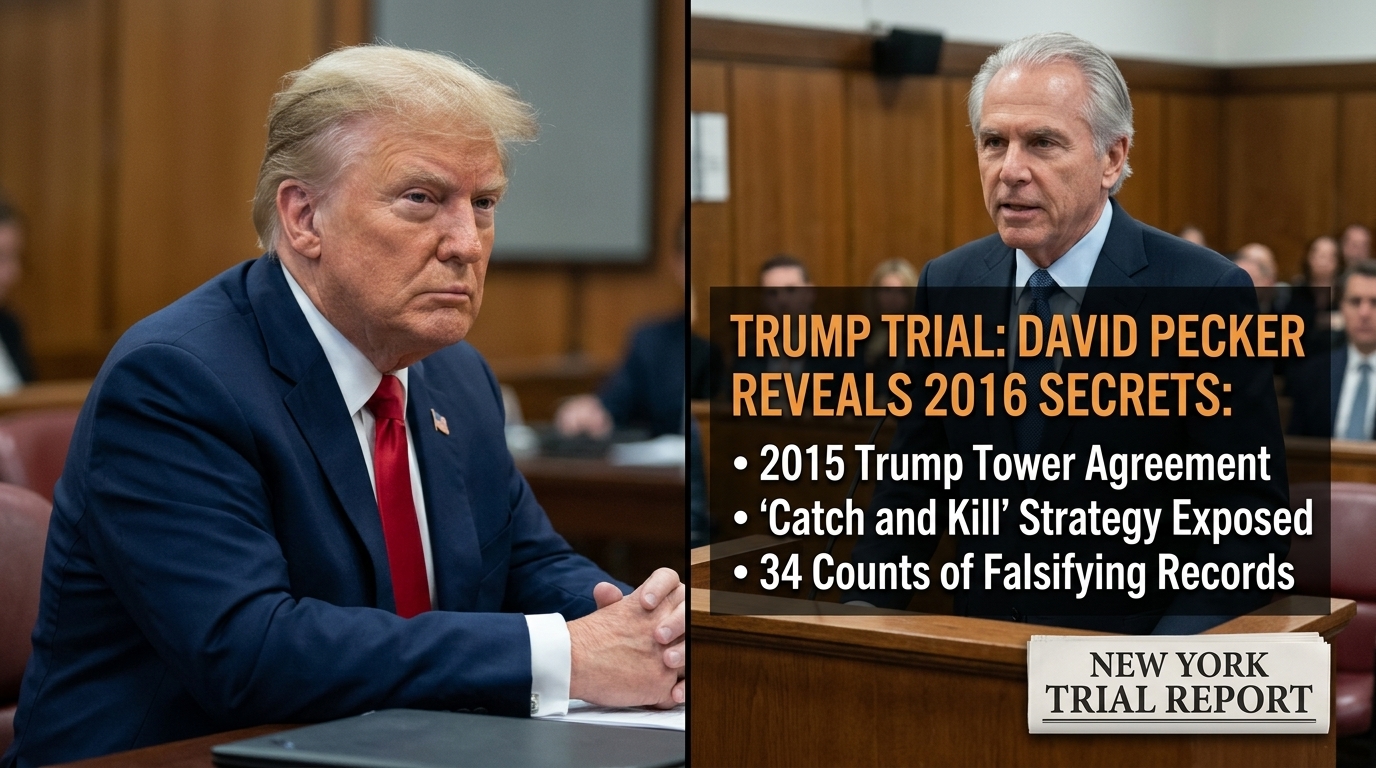
In April 2024, a pivotal moment in American legal history unfolded inside a Manhattan courtroom when David Pecker, the former publisher of the National Enquirer and chief executive of American Media Inc. (AMI), took the witness stand. Rather than standing as an outside commentator or a media ally, Pecker testified as a key prosecution witness in the criminal trial of former President Donald Trump.
His testimony pulled back the curtain on private arrangements that operated behind the scenes of the 2016 presidential election. What began as a tabloid executive helping an old celebrity associate became the cornerstone of the prosecution’s legal theory, connecting checkbook journalism directly to state-level criminal charges.
The 2015 Trump Tower Meeting: Becoming the ‘Eyes and Ears’
The prosecution’s narrative anchored itself in a private August 2015 meeting at Trump Tower involving Donald Trump, his personal lawyer Michael Cohen, and David Pecker. Having known Trump for decades during his career as a New York developer and television personality, Pecker testified that he agreed to assist Trump’s newly launched presidential bid through a three-part media strategy:
- Promoting Positive Coverage: Publishing favorable accounts of Trump’s campaign across AMI’s network of tabloids.
- Targeting Opponents: Running aggressive, negative coverage against Trump’s rivals in the Republican primaries and general election.
- Early Warning System: Acting as the campaign’s “eyes and ears” by monitoring tips, leads, and individuals attempting to sell damaging stories about Trump’s personal life.
This arrangement formed the infrastructure of what is known in the media industry as “catch and kill”: acquiring the exclusive publishing rights to an embarrassing story and intentionally burying it so the public never reads it.
The Catch and Kill Blueprint: From Doormen to Suppressed Stories
Purchasing a story or signing a non-disclosure agreement (NDA) is not inherently a criminal act. Publications regularly acquire exclusive rights, and public figures often manage their reputations. However, the legal stakes change entirely when financial transactions are alleged to be campaign-related expenditures designed specifically to prevent voters from learning negative information before an election.
Prosecutors introduced multiple transactions to establish that this was not an isolated practice, but a coordinated pattern:
- The Trump Tower Doorman ($30,000): AMI paid $30,000 to purchase the life rights of former Trump Tower doorman Dino Sajudin, who claimed to have an unverified story alleging Trump fathered a child out of wedlock. The story was investigated, deemed untrue, and buried.
- Karen McDougal ($150,000): In mid-2016, former Playboy model Karen McDougal sought to sell allegations of a prior relationship with Trump. With Cohen’s involvement, AMI secured her exclusive rights for $150,000 under a contract that masked the payment with secondary obligations, keeping the story entirely out of public circulation.
- The Stormy Daniels Payment ($130,000): In the final weeks before the November 2016 election, adult film actress Stormy Daniels prepared to publicly disclose allegations of a sexual encounter with Trump. While Pecker declined to have AMI finance this specific transaction directly, Cohen stepped in to pay Daniels $130,000 to execute an NDA.
Connecting Tabloids to 34 Felony Counts
While public attention fixated on celebrity gossip and hush money payments, the indictment itself was strictly technical. Trump was charged with 34 felony counts of falsifying business records in the first degree under New York penal law.
Under New York law, falsifying business records becomes a felony only if the falsification is committed with an intent to commit, aid, or conceal another crime. Prosecutors argued that the true crime being concealed was an unlawful effort to corrupt the 2016 election through illegal campaign contributions.
- The prosecution used Pecker’s account to build a continuous timeline connecting the initial 2015 Trump Tower pact to Cohen’s subsequent actions.
- Records generated by the Trump Organization recorded regular monthly reimbursements to Cohen throughout 2017 as standard legal expenses under an alleged retainer agreement.
- Prosecutors alleged these business records—spanning invoices, ledger entries, and signed checks—were systematically fabricated to disguise the repayment for suppressing the Daniels story.
The Battle Over Credibility and Legal Intent
The defense mounted a vigorous challenge against the prosecution’s witnesses and legal theories. Defense attorneys emphasized that Pecker was not an independent observer, but an active participant who had previously entered a non-prosecution agreement with federal prosecutors.
Furthermore, the defense argued that Michael Cohen’s history of prior federal convictions for lying to Congress and financial fraud rendered his testimony untrustworthy. They asserted that payments made to protect family members from personal embarrassment do not constitute election crimes, and that candidates retain the right to settle claims or protect their public image.
However, the prosecution avoided relying solely on witness memory. By presenting bank records, text messages, encrypted phone logs, and financial vouchers that matched Pecker’s testimony, prosecutors argued the physical paper trail independently corroborated the underlying arrangement.
The Verdict and Its Historic Significance
On May 30, 2024, after evaluating weeks of testimony and hundreds of exhibits, a Manhattan jury delivered a unanimous verdict: guilty on all 34 felony counts. The decision marked the first time a former U.S. president had been criminally convicted in a court of law.
David Pecker’s testimony proved vital because it bridged the gap between tabloid maneuvers and criminal intent. While headlines focused on sensational payouts, the trial established that modern political accountability often turns on business records, accounting entries, and statutory compliance rather than tabloid controversy.