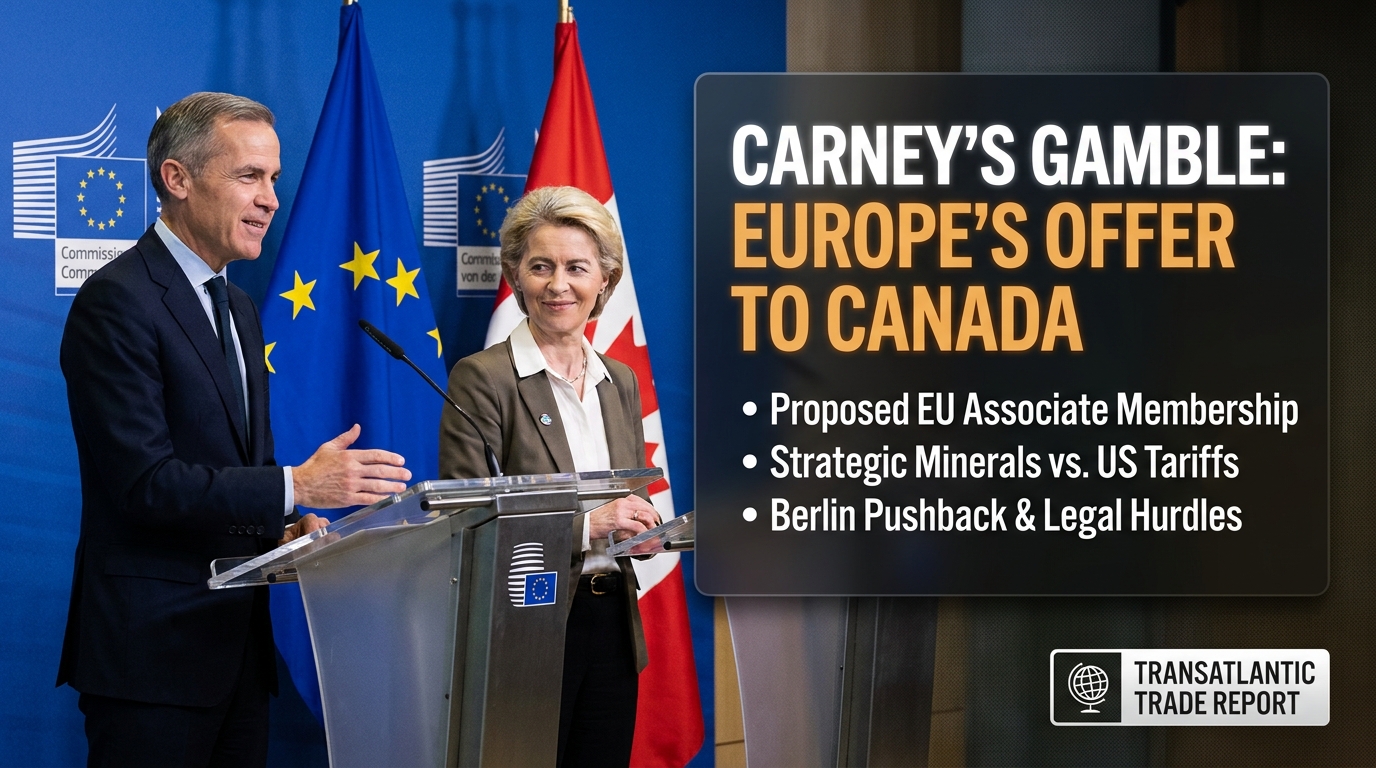
In Strasbourg, France, European Commission President Ursula von der Leyen delivered an extraordinary geopolitical proposal before the European Parliament, offering to open the door for Canada to become the European Union’s first-ever “associate member.” Standing alongside Canadian Prime Minister Mark Carney, von der Leyen received a standing ovation from European lawmakers as she framed the initiative as an urgent reimagining of Western alliances.
Yet behind the dramatic theater in Strasbourg lies a volatile economic reality. Triggered by a brutal trade and tariff dispute between Ottawa and Washington, Canada’s strategic pivot toward Brussels represents a high-stakes gamble that faces steep institutional roadblocks on both sides of the Atlantic.
The Fracture of the North American Economic Zone
For more than seven decades, the United States and Canada operated as a deeply integrated continental trading bloc, with roughly 70% of Canadian exports bound for American markets. However, the recent collapse of trade talks between Washington and Ottawa, paired with U.S. tariffs and Canadian retaliatory duties, has severely strained that framework.
Prime Minister Carney has framed the European pivot as a necessary defense of Canadian sovereignty against U.S. economic pressure. But replacing an immediate geographic neighbor with an ocean-separated regulatory power creates structural friction:
- Logistics Disparity: Transatlantic container shipping cannot replicate the speed and cost efficiency of North American freight rail and cross-border trucking.
- Economic Supply Chains: Disruptions to integrated North American supply chains threaten sudden cost pressures in automotive components, agriculture, and critical minerals.
- The Sunset Clause: Tensions place growing uncertainty on the future renewal of the United States-Mexico-Canada Agreement (USMCA).
The Strategic Bargain: Raw Minerals for Market Access
Europe faces a mounting raw materials crisis, mandated by the EU’s Critical Raw Materials Act to rapidly diversify industrial inputs away from Chinese dominance for green energy, aerospace, and advanced manufacturing.
Canada holds vast, untapped reserves of strategic resources—including lithium deposits in Quebec, high-grade uranium in Saskatchewan, and cobalt throughout the Canadian Shield. In exchange for granting European industry prioritized access to these critical minerals, Ottawa seeks deeper institutional alignment under a proposed “Alliance for the Future,” spanning defense manufacturing, clean tech, and Arctic security.
Legal and Diplomatic Realities Across European Capitals
Despite the enthusiasm in the European Parliament chamber, sovereign European governments hold the legal keys to any formal agreement, and several capitals—most notably Berlin—quickly voiced skepticism.
- The Unanimity Rule (Article 217): Under EU treaties, creating a binding association agreement requires the unanimous approval of all 27 member states. A single veto—whether from Germany protecting its trade interests or another member state—can derail the framework.
- The Precedent Dilemma: Granting Canada a bespoke, preferential status outside the standard accession pipeline risks provoking demands for equal access from the post-Brexit United Kingdom and candidate nations in the Western Balkans who have waited years for integration.
- Unfinished Business (CETA): The existing EU-Canada Comprehensive Economic and Trade Agreement (CETA) remains unratified by nearly a dozen EU national parliaments nearly a decade after signing, illustrating the slow pace of European treaty-making.
Fierce Domestic Backlash in Ottawa
Domestically, Carney’s European overture sparked immediate political opposition at home. Conservative Party Leader Pierre Poilievre condemned the initiative, arguing that pivoting from Washington to Brussels merely exchanges one form of external dependence for another.
Poilievre argued that Canadian industrial workers, prairie farmers, and maritime fishers should not be subjected to distant European regulatory bodies and environmental directives. Opponents contend that while Carney broke off U.S. negotiations under the banner of national sovereignty, accepting associate status will inevitably force Canada to align domestic policies with Brussels’ stringent regulatory frameworks.
What to Watch Ahead of the Montreal Summit
The true viability of the proposal will be tested on October 29–30, when European Union and Canadian leaders meet for a bilateral summit in Montreal.
Rather than producing a sweeping treaty, negotiators are expected to pursue pragmatic, sector-specific tie-ins—such as expanding Canadian participation in Horizon Europe research initiatives and selected defense programs. Whether this transatlantic bridge can offset the immense economic gravity of North American trade remains the definitive question facing Canada’s economic future.