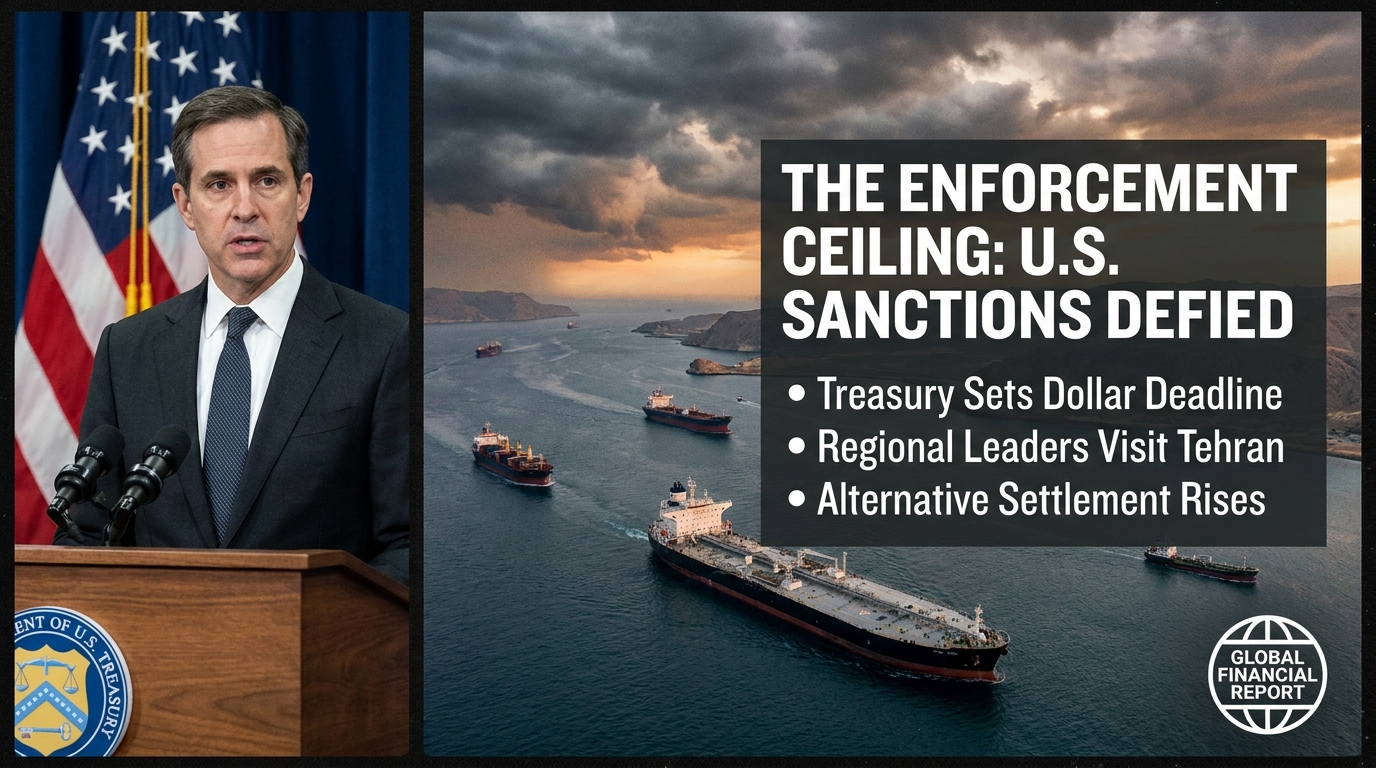
On August 24, 2026, the United States Treasury issued an explicit ultimatum to the international financial community. Washington warned that any state or corporate entity maintaining economic ties with Tehran faced a defined countdown: sever those ties completely or face expulsion from the U.S. dollar clearing system. Far from a standard diplomatic warning, the measure placed the dollar’s clearing network at the center of enforcement, expanding targeted sectors to include gold, digital assets, aviation, and technology alongside traditional oil and shipping sanctions.
The true test of financial power, however, lies in how the international system reacts once the clock starts. Within 48 hours, regional diplomacy diverged sharply from Washington’s mandate.
Diplomacy Over Compliance: The 48-Hour Response
According to official reporting, senior regional leaders engaged directly with Tehran almost immediately following the Treasury’s announcement:
- Pakistan’s Military Leadership: Pakistan’s army chief traveled to Tehran within roughly 24 hours of the deadline, meeting directly with senior Iranian officials and chief negotiators.
- Omani Diplomatic Engagement: Oman’s foreign minister arrived the following day for high-level talks focused specifically on security and navigation within the Strait of Hormuz.
Rather than isolating Iran, the deadline prompted immediate engagement from two strategically vital U.S. partners: a nuclear-armed regional power and Washington’s primary back-channel mediator in the Gulf.
Understanding the ‘Enforcement Ceiling’
When an ultimatum fails to command automatic compliance, it reveals what analysts term the enforcement ceiling—the threshold where increasing pressure yields diminishing political obedience. This dynamic operates across distinct phases:
- Forced Visibility: A public ultimatum eliminates gray zones. Countries that quietly traded or maintained diplomatic channels are forced to either visibly obey or openly ignore the policy.
- The Dollar Asymmetry: Threatening dollar exclusion works only when the targeted economies possess no alternative settlement routes. The expansion of bilateral clearing agreements, gold transactions, and non-dollar trade structures steadily erodes this pressure.
- Selective Enforcement Dilemmas: Washington cannot easily punish vital partners without damaging other core strategic interests, creating an enforcement gap that regional actors routinely exploit.
- Expanding Sector Lists: Repeatedly expanding sanctions to cover gold, cryptocurrency, and tech transfers reveals where previous controls failed, underscoring an enforcement framework attempting to keep pace with evasive financial networks.
Economic Squeeze vs. Strategic Obedience
Skeptics point out that internal economic indicators within Iran tell a story of immense financial pain. Severe inflation, sharp currency depreciation, and domestic supply constraints reflect the immense destructive capacity of U.S. sanctions.
However, an economy in severe distress does not automatically translate into strategic submission from its neighbors. While sanctions undeniably inflict heavy domestic costs on target states, they increasingly struggle to compel neighboring nations to sever indispensable regional relationships.
Key Signals to Monitor
To determine whether the enforcement ceiling is actively holding or beginning to buckle, observe these critical indicators:
- Direct Designations: Whether the U.S. Treasury officially sanctions specific Pakistani or Omani entities, or avoids penalizing them to protect broader diplomatic alliances.
- Subsequent Delegations: Whether additional regional governments follow suit by sending public diplomatic missions to Tehran.
- Alternative Settlement Volumes: Ongoing shifts toward gold transactions, local currency arrangements, and independent non-dollar settlement networks.
- Boutique Targeting: A shift in Washington’s enforcement strategy away from sovereign state actors toward smaller third-party shell companies and isolated individuals.