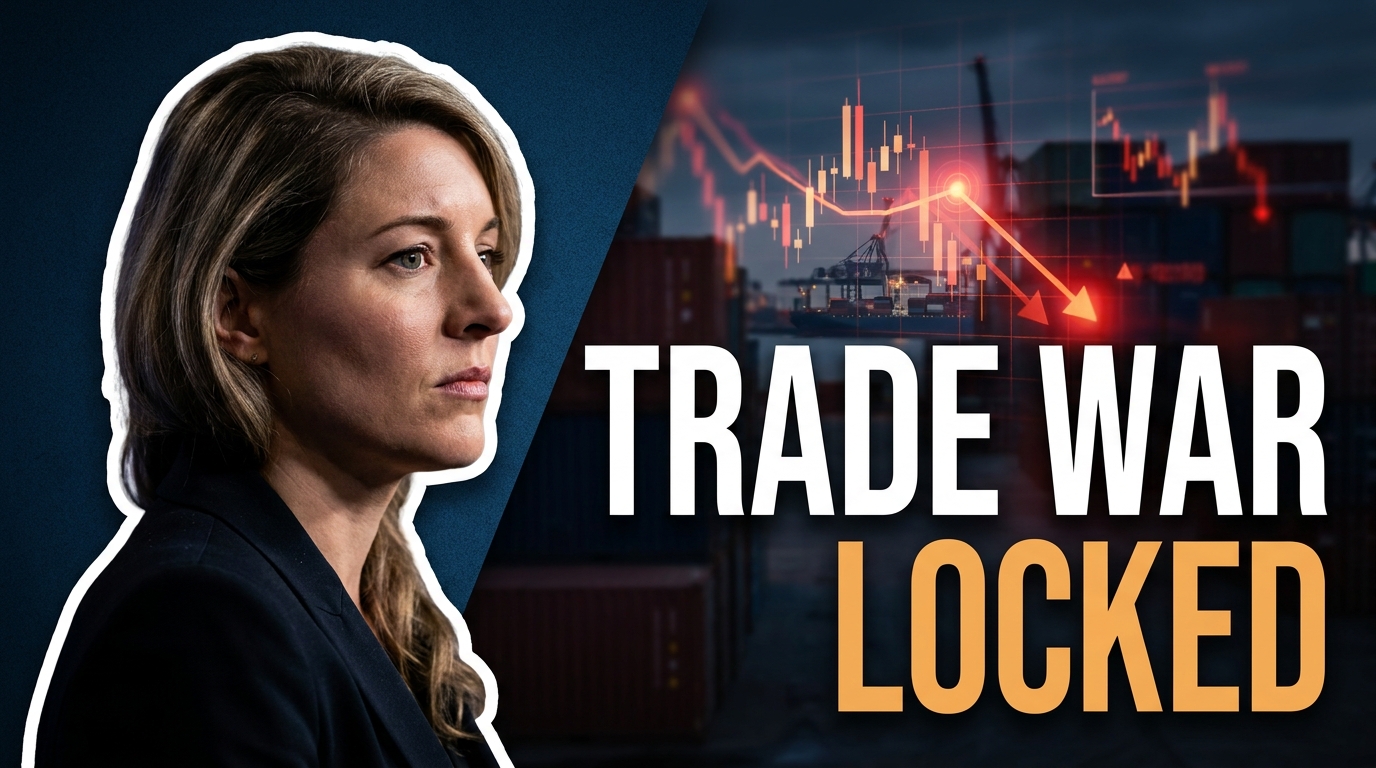
A historic rupture in North American economic relations unfolded when Canadian Industry Minister Mélanie Joly took the podium at a live national press conference. Presented with a direct opportunity to de-escalate tensions and walk back Ottawa’s aggressive rhetoric toward Donald Trump, Joly refused to concede an inch. Instead, she delivered an unyielding statement of doctrine: “We’re ready.”
The statement confirmed what trade analysts across Washington and Ottawa had feared: diplomatic accommodation has officially ended. The collapse of bilateral negotiations over automotive rules, cross-border shipping, and trade protectionism has locked the continent into a full-scale economic confrontation. After the White House moved toward implementing a 50% tariff on roughly $28 billion worth of Canadian goods, Ottawa responded by authorizing equal counter-tariffs designed to maximize pressure on vulnerable U.S. industrial and political sectors.
The War Footing: From Compromise to Confrontation
Joly’s refusal to yield reflects a coordinated, whole-of-government strategy rather than an isolated political remark. Her position was reinforced with identical resolve by Canadian Prime Minister Mark Carney following the collapse of cross-border talks: “You’re at war when you’re attacked, and we got attacked.”
For decades, the standard playbook between Ottawa and Washington relied on an asymmetric dynamic. Whenever Washington threatened unilateral trade penalties, Canadian governments historically sought exemptions by appealing to shared cultural ties, continental defense treaties, and integrated history.
That playbook has now been abandoned. Ottawa has concluded that appeasement no longer works against an administration that treats international commerce as an instrument of national subordination. Instead, Canadian leadership is responding with targeted macroeconomic retaliation.
The Mechanics of Decoupling: Activating the Capital Pivot
For more than half a century, Canada’s economic model was anchored to a fundamental reality: over 70% of Canadian exports flowed south across the 49th parallel. Today, Ottawa is actively triggering contingency mechanisms to dilute that dependency through what economists call a structural capital pivot:
- Courting Global Sovereign Capital: While trade lines harden, Canadian leadership has pitched international institutional investors managing a combined $87 trillion in assets. The objective is to position Canada’s triple-A sovereign credit rating and institutional stability as a premier destination for global capital fleeing U.S. policy volatility.
- Financing Strategic Infrastructure: Capital is being targeted directly into domestic nuclear power expansion, semiconductor-grade critical minerals, and clean-energy infrastructure tailored for next-generation artificial intelligence data facilities.
- Overseas Supply Redirection: Rather than absorbing U.S. import penalties on Canadian raw materials, Ottawa is structuring alternative trade corridors to channel high-grade aluminum, softwood lumber, uranium, and energy directly to long-term partners across Europe, Japan, and the United Kingdom.
Sovereignty, National Defense, and the 51st State Rhetoric
The current standoff is rooted in structural disputes over national sovereignty that predate recent tariff threats. During prior international summits, suggestions that Canada could be absorbed as a “51st state” were firmly rejected by Canadian officials. Joly delivered a direct warning to U.S. Secretary of State Marco Rubio, emphasizing that Canadian sovereignty is non-negotiable.
Treating a sovereign ally as a hostile trading adversary degrades the institutional trust underpinning continental agreements, most notably the United States-Mexico-Canada Agreement (USMCA). By invoking unilateral national security justifications to impose trade penalties on Canadian industry, Washington signals to global partners that North American trade pacts remain subject to unpredictable executive revision.
The Integrated Factory Floor: Supply Chain Realities
What political strategists frequently misunderstand is that the U.S.-Canada border is not an ordinary boundary—it functions as a unified industrial factory floor. In the automotive and advanced manufacturing corridors, parts, assemblies, and raw inputs frequently cross the border multiple times before a finished product rolls off the line:
- Automotive Sector Shockwaves: Retaliatory duties on auto components trigger instant cost overruns for assembly plants in Michigan, Ohio, and Ontario alike, threatening output quotas.
- Construction and Housing Costs: Punitive tariffs on Canadian softwood lumber and structural steel translate directly into higher residential building costs, compounding existing housing affordability pressures across American cities.
- Consumer Inflation: Because Canada’s counter-tariffs are surgically targeted at consumer goods and agricultural products produced in politically competitive congressional districts, price increases will fall squarely on households long before Ottawa exhausts its financial resolve.
Long-Term Consequences for Portfolios and Daily Life
For households, retirees, and institutional investors managing North American equities, a prolonged trade war represents a structural shift toward persistent cost friction. Supply chain disruptions inevitably erode corporate margins, force central banks to maintain higher interest rates to combat import inflation, and increase volatility across diversified index funds.
Mélanie Joly’s declaration was more than political rhetoric; it signaled the permanent arrival of a new economic paradigm. Canada is no longer negotiating for regulatory exemptions from Washington. Instead, it is actively constructing an independent economic buffer, preparing both its domestic industries and international partnerships for an extended continental siege.