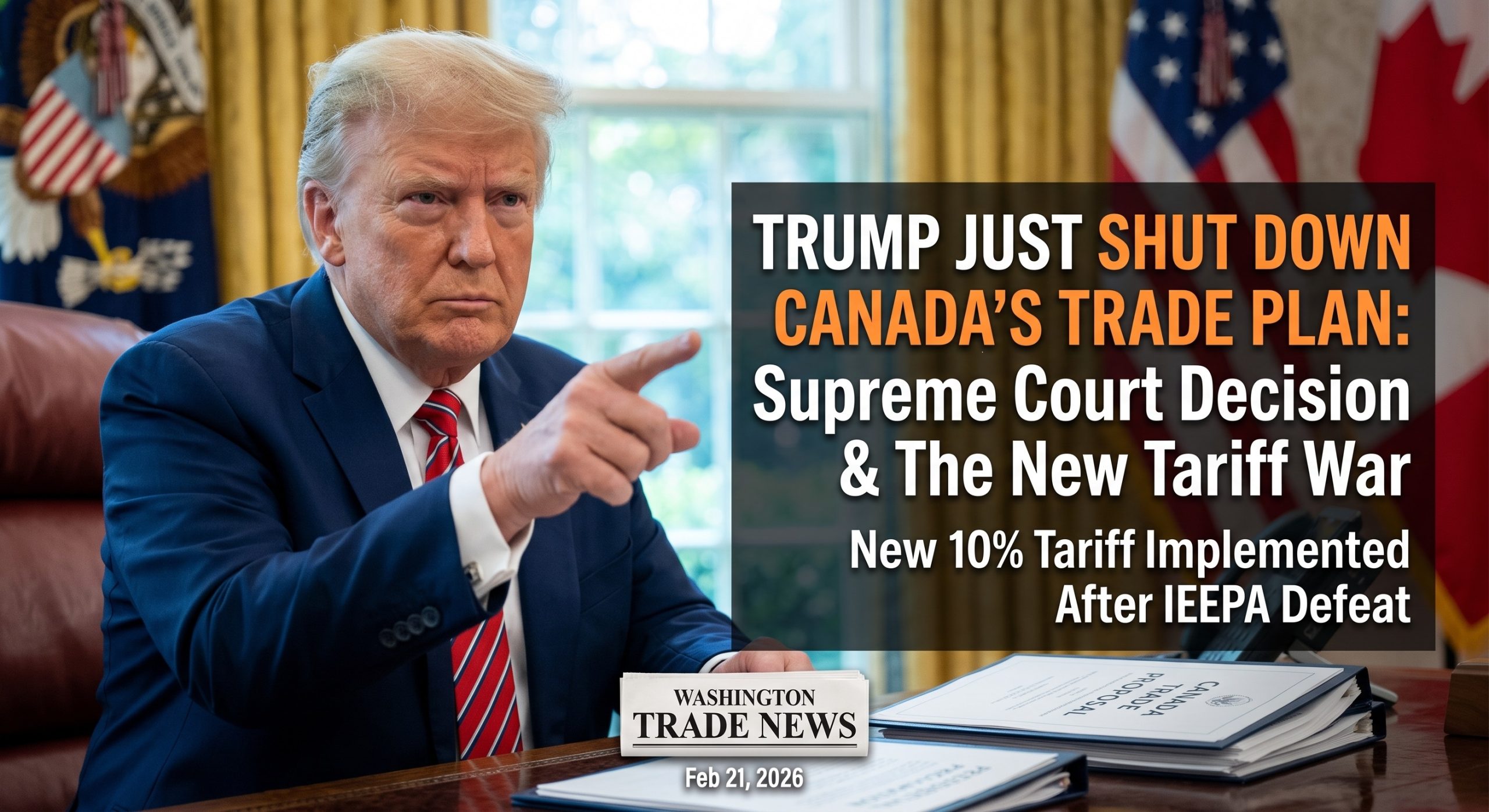
A pivotal turning point in American economic policy occurred on February 20, 2026, when the Supreme Court delivered a landmark 6-3 ruling against President Donald Trump’s primary tariff mechanism. Far from being a routine disagreement over import duties, the dispute reached into the core framework of the U.S. Constitution: who holds the authority to tax imported goods—the President or Congress?
While critics initially celebrated the ruling as the end of sweeping tariffs, the legal reality quickly proved otherwise. The court rejected one specific legal justification, prompting the White House to immediately deploy alternative trade statutes. This rapid pivot has reshaped the economic battlefield, creating new complications for businesses, financial markets, and trading partners like Canada.
The 6-3 Ruling: The Limits of Emergency Powers
The central issue before the Supreme Court was not whether tariffs are inherently lawful, but whether Congress authorized them under the International Emergency Economic Powers Act (IEEPA) of 1977.
- The Administration’s Argument: Broad emergency authority over international economic transactions extends to levying import duties.
- The Majority Decision (6-3): Chief Justice John Roberts authored the majority opinion, stating that sweeping tariff powers cannot simply be implied from a statute that does not explicitly grant them.
- The Dissent: Justices Clarence Thomas, Samuel Alito, and Brett Kavanaugh dissented, arguing in favor of executive discretion.
While President Trump criticized the ruling as deeply disappointing, the decision was governed by constitutional separation of powers and the major questions doctrine, holding that extraordinary executive actions affecting the wider economy require clear congressional authorization.
The Immediate Pivot: Section 122 and Alternative Statutes
The Supreme Court did not revoke all presidential tariff authority. Recognizing the narrow scope of the decision, the administration acted swiftly on the very same day by issuing a proclamation under Section 122 of the Trade Act of 1974.
- A temporary 10% import surcharge was implemented to address international payments imbalances, taking effect on February 24.
- The White House reinforced its reliance on targeted mechanisms, including Section 232 (national security) and Section 301 (unfair trade practices).
- Instead of relying on a single broad emergency declaration, the administration adopted a framework requiring separate agency investigations, explicit statutory findings, and distinct legal justifications.
Trade Fallout: Canada and Global Supply Chains
The ripple effects of this regulatory shift extended far beyond the courtroom, hitting international trade relationships—especially with Canada. Integrated supply chains across energy, automotive components, and agriculture faced sudden operational adjustments.
Canada responded with retaliatory tariffs targeting approximately $20 billion worth of U.S. goods, igniting a retaliatory cycle that pressured manufacturers on both sides of the border. Simultaneously, complex negotiations with partners like Mexico accelerated ahead of the midterms, illustrating how tariffs continue to serve as aggressive leverage in international diplomacy.
The Financial Dilemma: Revenue and the Refund Crisis
Beyond the political and diplomatic conflicts, the Supreme Court’s decision triggered a massive financial dispute over customs revenue collected under the invalidated IEEPA rules.
- Customs duties generated $292.5 billion in gross collections during the fiscal year, yielding $167.3 billion in net revenue after $125.2 billion in total refunds across all customs operations.
- Processing refunds for invalid duties introduces years of potential litigation, as agencies must trace thousands of import transactions, fluctuating tariff rates, and corporate exemptions.
- Prolonged legal uncertainty poses significant planning risks for businesses adjusting supply chains, inventory, and consumer pricing.
A Lasting Constitutional Precedent
The Supreme Court did not end the trade war; it established boundaries on how it must be fought. Moving forward, the executive branch cannot rely on vague emergency statutes to unilaterally alter trade policies without explicit congressional delegation. While the administration’s broader economic agenda remains active, every future tariff measure now faces tighter statutory guidelines, higher administrative burdens, and rigorous judicial oversight.