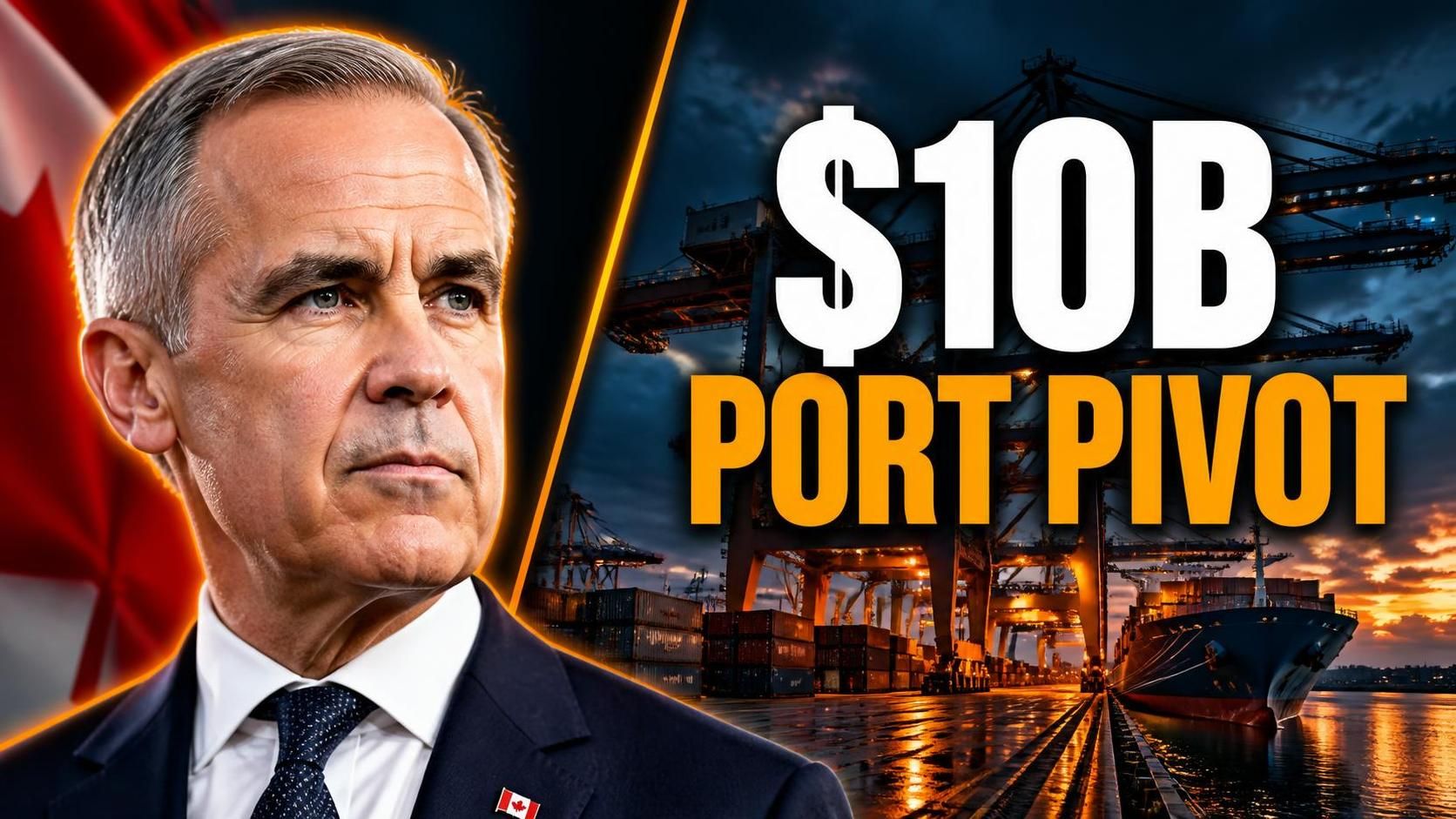
A fundamental restructuring of North American geopolitics is underway as Canadian Prime Minister Mark Carney advances a massive $10 billion infrastructural commitment to expand the Port of Vancouver. Designed explicitly to diversify trade routes away from the United States and establish direct maritime corridors to Asian markets, the initiative represents a permanent structural realignment of continental supply chains.
In direct response, the White House has moved to target a critical $10 billion Canadian export sector—potash and agricultural fertilizers—testing whether Ottawa can withstand the severe economic shock of the decoupling it has initiated.
The Chronology of the Fracture: August to September 2026
The escalation accelerated rapidly across a compressed timeline:
- Late August 2026: Canadian Prime Minister Mark Carney formally suspended trade negotiations with Washington, declaring that U.S. demands threatened national sovereignty. Within 24 hours, the United States imposed 50% tariffs on roughly $20 billion of Canadian goods, striking at cross-border manufacturing.
- Early September 2026: Ottawa enacted dollar-for-dollar retaliatory levies, targeting agricultural machinery, steel, and dairy from key U.S. states.
- Mid-September 2026: The conflict escalated beyond standard trade disputes as the Trump administration announced import bans on Canadian alcoholic beverages, furniture, and motorbikes, alongside 50% tariffs on an additional 100 goods categories.
- The Present Phase: The White House is preparing economic measures against Canadian potash and fertilizer inputs, while Ottawa officially pursues associate membership within the European Union and advances massive domestic energy independence projects.
The Strategic Mechanics: Port Expansion and Energy Sovereignty
For decades, economic integration across the 49th parallel operated on a core asymmetry: roughly 75% of all Canadian export volume flowed directly south, bound to the gravitational pull of the American market.
Carney, drawing on his extensive tenure as governor of both the Bank of Canada and the Bank of England, recognizes that diplomatic leverage requires heavy physical infrastructure. Without a modernized Pacific gateway, threats of trade diversification remain rhetorical. The $10 billion Port of Vancouver expansion provides the physical capacity required to bypass the North American rail network entirely.
Simultaneously, Ottawa has rolled out an unprecedented $70 billion clean-energy initiative—described as the functional equivalent of 18 Hoover Dams. This project secures domestic industrial electrification while preserving Canada’s ultimate strategic deterrent: unhindered energy and hydroelectric exports to the American Northeast.
Surgical Retaliation vs. Broad U.S. Enforcement
The two nations are deploying entirely different economic weapons:
- Ottawa’s Surgical Tariffs: Conscious of its smaller economic scale, Canada targeted high-impact, localized sectors in U.S. swing states—including Michigan, Ohio, Iowa, Maine, and North Carolina—aiming to exert political pressure on the electoral coalition without triggering total supply chain collapse.
- Washington’s Fertilizer Pressure: The United States Trade Representative (USTR) is focusing on Canadian potash. Because Canada supplies the vast majority of agricultural fertilizer utilized across the American Midwest, heavy import taxes on potash threaten to artificially inflate baseline production costs for corn, soybeans, and wheat.
The Counterargument: Can Canada Successfully Decouple?
Skeptics argue that Carney’s pivot is logistically impossible in the short term. Constructing multi-billion-dollar maritime infrastructure takes years of engineering and regulatory review. Until the Port of Vancouver expansion is fully operational, Canadian exporters remain structurally bound to the North American logistics network.
However, this skepticism overlooks Ottawa’s parallel diplomatic maneuvers. By actively pursuing an associate membership framework with the European Union, Canada is building immediate regulatory and institutional firewalls that bypass Washington entirely, locking in long-term trade agreements before physical port construction concludes.
Downstream Consequences for Consumers and Portfolios
When two tightly integrated economic blocs dismantle shared supply chains, the immediate byproduct is structural inflation:
- Construction & Housing Costs: Sustained tariffs on Canadian lumber, plastics, and electrical equipment raise residential building costs, compounding housing affordability pressures.
- Agricultural Inflation: Retaliatory duties and fertilizer taxes translate directly into higher grocery bills for American consumers at checkout counters.
- Retirement & Fixed-Income Risks: Persistent import inflation erodes purchasing power, threatening savings and increasing portfolio volatility across North American equities.
The core unresolved question of the decade is no longer whether the historical trade pact is fracturing, but which economy will absorb the first breaking point as the physical architecture of North America is rewritten in real time.